 HomeCountiesArticlesMethodologyContact
Why Every Conversation About AI and Jobs Is Meaningless Without a Time Frame — a Three-Horizon Framework for Municipal Leaders
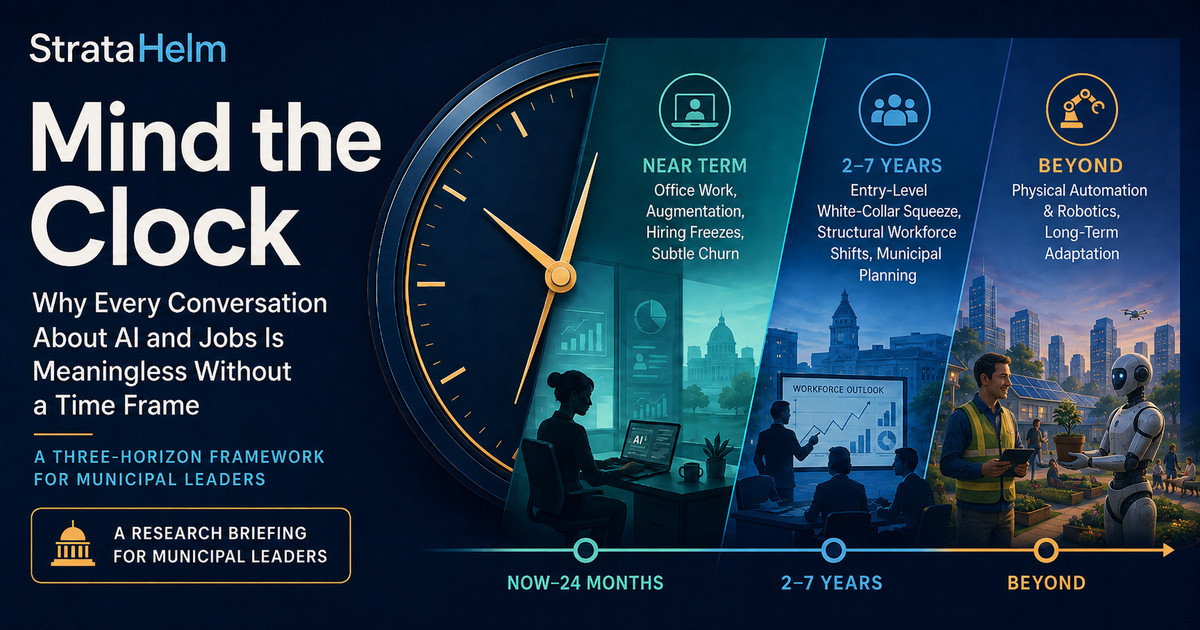
"Will AI take our jobs?" is a badly formed question, and badly formed questions produce badly formed policy. The honest answer depends entirely on the clock: over the next 24 months, employment in many AI-exposed occupations may hold steady or even grow while the overall economy stays healthy; over a three-to-seven-year horizon, credible forecasters warn of deep cuts to entry-level white-collar work; and over the longer horizon, falling robot costs extend the question to physical labor that is "safe" today. These are not competing predictions — they are different points on the same curve. This briefing proposes a simple discipline for local leaders: no statement about AI and employment should be made, quoted, or acted upon without an explicit time horizon attached. We then map the best available evidence onto three horizons and show what each one asks of a municipality.
In May 2025, Anthropic CEO Dario Amodei warned that AI could eliminate up to half of all entry-level white-collar jobs within one to five years (Fortune, 2025). Nvidia CEO Jensen Huang publicly pushed back. The World Economic Forum projected 92 million jobs displaced by 2030 — alongside 170 million created (WEF, 2025). Microsoft’s AI chief predicted most professional work automated within 18 months (Fortune, 2026), while Anthropic’s own 2026 worker-survey research found jobs changing far more than vanishing — so far (Anthropic Economic Index, 2026). To a reader, this sounds like chaos. It is mostly a failure to timestamp. A claim about 2026, a claim about 2030, and a claim about 2040 can all be simultaneously true — and each demands a different municipal response. When your economic development director, your newspaper, and your loudest constituent are all arguing about different decades without saying so, paralysis is the natural result.
Rule of thumb for every AI-and-jobs claim you encounter: no date, no debate.
The near-term data describes disruption at the edges, not collapse. Research on early AI adoption finds usage concentrated in software development and writing tasks, with roughly 36 percent of occupations using AI for at least a quarter of their tasks — mostly as augmentation (Anthropic Economic Index). The measurable pain is concentrated and specific: a Stanford Digital Economy Lab analysis of millions of ADP payroll records found that since late 2022, early-career workers (ages 22–25) in the most AI-exposed occupations have experienced a 16 percent relative decline in employment even after controlling for firm-level shocks — with young software developers down nearly 20 percent from their late-2022 peak — while experienced workers in the same occupations have remained stable or grown (Brynjolfsson, Chandar & Chen, 2025). Meanwhile some AI-adjacent occupations are genuinely growing — machine-learning specialists, data and integration roles, AI-oversight functions (WEF, 2025).
Here is the trap for local leaders: headline unemployment and total employment can look perfectly healthy through this entire phase. The damage hides in hiring freezes for new graduates, quiet non-replacement of departing staff, and shrinking job postings — indicators most municipal dashboards do not track. A leader who says "AI hasn’t hurt us — look at the unemployment rate" in this window is reading yesterday’s instrument panel.
The middle horizon is where forecasts turn serious. Amodei’s warning — up to 50 percent of entry-level white-collar roles within five years, with unemployment potentially reaching 10–20 percent in adverse scenarios — is the most-quoted, but it is directionally echoed by more conservative sources: independent syntheses project 15–25 percent of jobs significantly disrupted by the late 2020s with perhaps 5–10 percent net displacement after accounting for job creation (AIMultiple, 2026). The WEF’s 2030 projection of 92 million displaced against 170 million created sounds comforting until you read the fine print: the same report projects that a large share of workers’ core skills will change by 2030, and the fastest-growing roles — AI specialists, data and security roles — demand different skills, and often sit in different regions, than the roles being displaced (WEF, 2025). Displacement and creation being equal in national totals is cold comfort if they are unequal in your county. For a municipality, this is the horizon where the composition of your workforce matters more than the size of it: a town heavy in routine cognitive work (claims processing, basic accounting, customer support, junior legal and administrative roles) carries concentrated exposure exactly the way 1970s Youngstown carried steel exposure.
Today’s standard advice — trades and physical work are safe — is true and timestamped. The economics of embodied AI are moving fast: entry-level humanoid robots are already selling in the $13,500–$30,000 range, Goldman Sachs found manufacturing costs fell roughly 40 percent in a single year (double analyst forecasts), and industry projections put capable units at $10,000–$20,000 by 2030 (RoboZaps, 2026; Bank of America/UBTech forecasts). Against industry estimates of fully loaded U.S. manufacturing labor costs on the order of $150,000 per worker per year (wages plus benefits, overhead, and payroll taxes), the arithmetic writes itself. Important honesty: current deployments remain small and frequently over-hyped — Tesla reportedly produced only hundreds of Optimus units against a multi-thousand-unit 2025 target, with Elon Musk acknowledging in late 2025 that the program remained in an R&D phase, and real-world usefulness today is largely confined to factory pilots at firms like BMW and Mercedes (industry deployment trackers and press reports, 2025–2026). But "not yet" is a time-frame statement, not a safety guarantee. A leader retraining displaced office workers into warehouse and routine physical roles should understand those roles carry their own, later expiration risk — and prioritize the harder-to-automate versions: installation, repair, care work, and skilled trades in unstructured environments.
Time-framing is not just analysis — it is public leadership. Residents hear "AI will take half the jobs" and "AI is creating jobs" in the same news cycle and conclude that nobody knows anything. A mayor who consistently says "here is what we expect in the next two years, here is what we are preparing for in five, and here is how we stay flexible beyond that" converts anxiety into a plan. The clock is not a technicality. It is the difference between panic and preparation.
Horizon One asks one concrete thing of a municipality: instrument the dashboard. StrataHelm publishes a free exposure read for every county in the United States — a starting look at which local occupations sit closest to the front of the clock. Look up your county →
AIMultiple (2026). "Top 20+ Predictions from Experts on AI Job Loss." aimultiple.com.
Anthropic Economic Index (2026). "Cadences" edition pairing worker surveys with usage data; and prior task-usage analyses. anthropic.com.
Barclays Investment Bank (2026). "Robots Roll Out, Economies Rewire." Equity Gilt Study, 71st ed. ib.barclays.
Brynjolfsson, E., Chandar, B., & Chen, R. (2025). "Canaries in the Coal Mine? Six Facts about the Recent Employment Effects of Artificial Intelligence." Stanford Digital Economy Lab. digitaleconomy.stanford.edu.
Fortune (2025). "Anthropic CEO Warns AI Could Wipe Out 50% of Entry-Level White-Collar Jobs." fortune.com.
Fortune (2026). "Anthropic Just Mapped Out Which Jobs AI Could Potentially Replace." fortune.com.
RoboZaps (2026). "Humanoid Production Economics" and "Humanoid Robots & Jobs: Economic Impact." blog.robozaps.com.
World Economic Forum (2025). "The Future of Jobs Report 2025." weforum.org.