 HomeCountiesArticlesMethodologyContact
Why "Just Learn a Trade" Is Real Advice for the Class of 2030 — and a Mirage for the Class of 2005
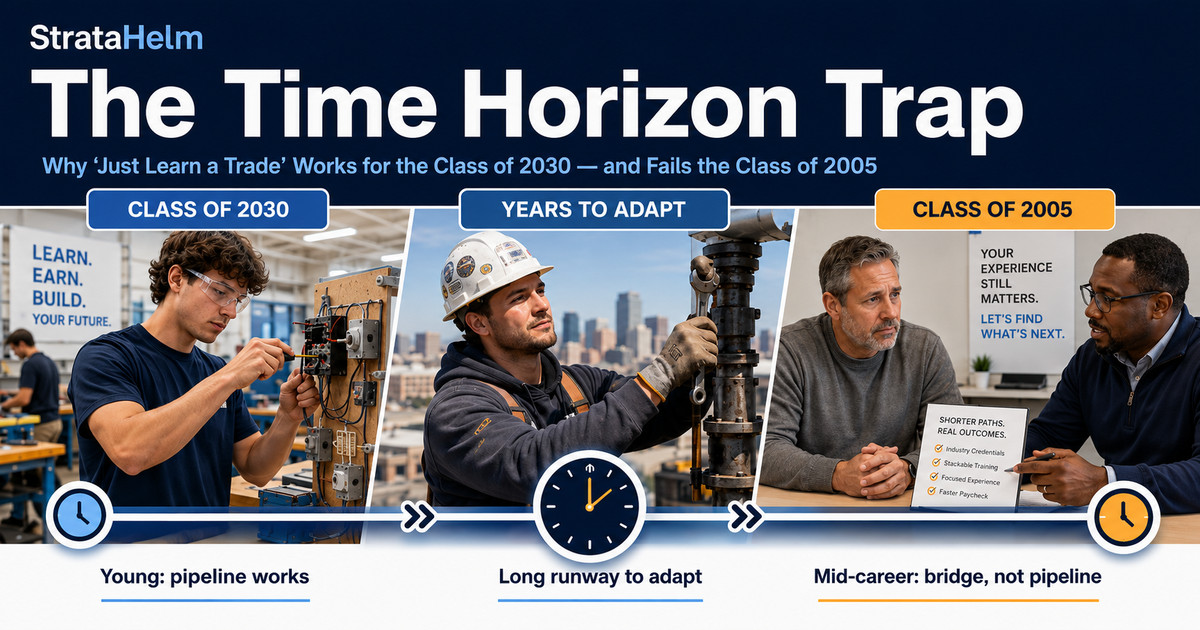
As AI pressure builds on white-collar work, the most common career advice in America has become some version of "go into the trades or healthcare." The advice is half right — and the half matters enormously for local policy. Demand in those fields is real, large, and well documented. But the pipelines into them are long and capacity-constrained: electrical apprenticeships run four to five years, and nursing schools turned away more than 65,000 qualified applications in a single academic year for lack of faculty and clinical slots. For a 19-year-old choosing a path, the time horizon is an asset — earn-while-you-learn training, no student debt, and a labor market begging for them at the other end, with whatever automation risk eventually reaches the trades arriving late enough to adapt to. For a 48-year-old claims processor with a mortgage, the same pipeline is arithmetic that does not work: years of apprentice or student wages against full-freight family obligations, followed by a shortened career over which to recoup the investment. The displaced mid-career worker does not typically enter the licensed trade or clinical role; they enter the low-barrier segments nearby — home health aide, warehouse, delivery — where wages are lowest and, in the case of care work, effectively price-capped by public reimbursement rates. Municipal leaders therefore need not one retraining strategy but two: a pipeline strategy for the young, and a fundamentally different — shorter, subsidized, employer-anchored — transition strategy for the mid-career. Treating these as one program is how retraining money gets spent and wasted.
Start with what the optimists have right. The demand side of the trades and healthcare is not hype. The Bureau of Labor Statistics projects healthcare and social assistance to be the fastest-growing and largest-adding sector in the economy through 2034 (+8.4 percent, roughly 2 million jobs), with about 1.9 million openings per year in healthcare occupations counting replacement needs (BLS, 2025). Electrician employment is projected to grow 9 percent — three times the all-occupation average — with roughly 81,000 openings a year, and nearly 30 percent of union electricians at or near retirement age (BLS; Electrical Contractor Magazine analyses). The AI buildout itself is pouring fuel on the fire: staffing firm Randstad’s analysis of over 150 million job postings found demand for skilled trades grew 27 percent from 2022 to 2026 — outpacing the overall labor market by 11 points — while skilled-trade wages grew about 30 percent over the same window (Randstad, via CNBC and press reports, 2026). Young people have noticed: in one widely reported 2026 survey, 60 percent of Gen Z respondents said they planned to pursue skilled trade work (ResumeTemplates.com, 2026). None of this is wrong. The question is who can actually walk through the door.
Here is the part the advice omits. The high-wage, high-security versions of these careers sit behind long, capacity-constrained pipelines:
The uncomfortable insight: the same licensing and apprenticeship walls that protect wages inside these fields are the walls that keep displaced workers out.
For a young person, the pipeline is a feature. Apprentices earn while they learn — entering at a meaningful fraction of journeyman wages and graduating debt-free into a market with a documented shortage. A registered apprentice who starts in their late teens can reach journeyman earnings by their mid-twenties having carried no tuition debt and positive income throughout: a payback period measured in a few years, not decades. The timing also matches the disruption: the Stanford Digital Economy Lab’s analysis of ADP payroll data shows the AI shock landing hardest on early-career workers (ages 22–25) in exposed occupations — a 16 percent relative employment decline since late 2022 (Brynjolfsson, Chandar & Chen, 2025). For a 20-year-old deciding between an entry-level marketing job and an electrical apprenticeship, the trade is arguably the lower-risk asset for the first time in a generation. Municipal investments in pre-apprenticeship programs, trades exposure in high schools, and community college clinical capacity are, on this evidence, well aimed.
A fair challenge to everything above: someone licensing in a skilled trade between now and 2033 expects to be working into the 2060s. Can anyone credibly promise that capable machines will not reach that work within four decades? No — and this briefing will not pretend otherwise. Our companion piece argues that today’s "the trades are safe" advice is true but timestamped, and that falling robot costs eventually put a clock on physical work too. It would be intellectually dishonest to make that argument there and quietly exempt the trades here.
Three things keep that uncertainty from undermining the case for the young, and one changes what we should recommend.
So the honest version of the claim is not "the trades are safe for forty years." It is that the trades are the better relative bet, their risk arrives later than the risk facing routine cognitive work, and the intervening years buy something valuable: capital, standing, and time to adapt. That is a weaker promise and a far more defensible one. It also carries a practical instruction — within the trades, steer young people toward service, repair, retrofit, and diagnostic work in unstructured environments rather than toward routine, repetitive installation in controlled or prefabricated settings. The first category is where the human advantage lasts longest.
Now run the same numbers for a mid-career displaced worker, and three things break at once.
First, the income gap during training. The randomized-trial success stories in workforce development — Project QUEST, Year Up, Per Scholas — share a demanding feature: full-time enrollment, sustained for months to years (Straight Talk on Evidence, 2019). A 48-year-old with a mortgage, dependents, and a health plan cannot live on apprentice wages or a training stipend the way a 19-year-old living at home can. This is not a motivation problem; it is a cash-flow problem.
Second, the payback window. A five-year credential completed at 50 leaves roughly twelve to fifteen working years to recoup forgone earnings — against a documented baseline in which displaced workers suffer persistent earnings losses of 15–25 percent, with losses largest for older, high-tenure workers and those forced to switch industries (Jacobson, LaLonde & Sullivan, 1993; Couch et al., 2009, via U.S. DOL synthesis). The net-present-value calculation that is obvious for the young becomes genuinely marginal in mid-career.
Third, the seats go to the young anyway. When nursing programs turn away 65,000+ qualified applicants and apprenticeship slots are rationed, capacity flows to applicants with the longest expected career over which employers and unions can recover training investments. The mid-career applicant is competing for a rationed seat with a structural disadvantage.
The result, visible in the federal retraining record, is sobering: the national Trade Adjustment Assistance evaluation found that even among displaced workers who completed training, only about 37 percent found jobs in their field of training — and TAA’s population skewed exactly toward the older, high-tenure workers described here (The Century Foundation, 2021; D’Amico & Schochet, 2012).
If the licensed roles are gated, where does the displaced 48-year-old actually go? Into the adjacent low-barrier segments: home health and personal care (high school diploma or less, 765,800 openings per year, median wage $34,900), warehousing, delivery, retail, food service (BLS, 2025). Two problems follow. The first is the pay cut — often 40–60 percent against a former back-office salary. The second is structural: in care work, the largest of these absorbing occupations, wages are not set by supply and demand alone but substantially by Medicaid and Medicare reimbursement rates — they are administratively priced. An influx of displaced workers into a price-capped occupation produces exactly the wage stagnation that a simple "healthcare is growing" narrative conceals. Growth in an occupation and prosperity in that occupation are different claims.
None of this means mid-career transition is impossible — the Project QUEST RCT population was largely adults, and it produced earnings gains lasting fourteen years (Economic Mobility Corporation; Economic Mobility Catalog, 2024). It means the design requirements are different and more expensive per person:
"Learn a trade" is good advice wearing a bad generalization. For the young, the trades and clinical careers are a genuinely strong bet — arguably the strongest in a generation, and one whose risks, if they arrive, arrive late enough to be adapted to — and communities should build those pipelines aggressively. For the mid-career displaced, the same advice describes a door that is four to five years away, behind a rationed queue, at wages they cannot afford during the walk. A municipality that funds one undifferentiated "retraining program" will report enrollment numbers and quietly fail its hardest cases. A municipality that runs two deliberately different strategies — a pipeline for the young and a subsidized, shortened, employer-anchored bridge for the mid-career — is doing the version of workforce policy the evidence actually supports.
American Association of Colleges of Nursing (2024–2026). Enrollment and Graduations survey data; Faculty Shortage Fact Sheet. aacnnursing.org.
Bloomberg / Insurance Journal (2026). "Labor Crunch Tests Growth Limits for US Data Center Builders." insurancejournal.com.
Brynjolfsson, E., Chandar, B., & Chen, R. (2025). "Canaries in the Coal Mine? Six Facts about the Recent Employment Effects of Artificial Intelligence." Stanford Digital Economy Lab.
CNBC (2026). "How the Red-Hot AI Data Center Boom Is Igniting Demand for Trade Workers," citing Randstad and Associated Builders and Contractors data. cnbc.com.
D’Amico, R., & Schochet, P. (2012). "The Evaluation of the Trade Adjustment Assistance Program: A Synthesis of Major Findings." U.S. Department of Labor / Mathematica Policy Research (including Couch et al. 2009 and Jacobson et al. 1993 findings on displaced-worker earnings losses).
Economic Mobility Catalog / Results for America (2024). "Sector-Specific Job Training" (Project QUEST 14-year RCT follow-up). catalog.results4america.org.
Electrical Contractor Magazine / ABLEMKR (2026). "The State of Skilled Labor in Electrical," citing BLS Employment Projections and union retirement data.
Jacobson, L., LaLonde, R., & Sullivan, D. (1993). "Earnings Losses of Displaced Workers." American Economic Review, 83(4), 685–709.
Moravec, H. (1988). Mind Children: The Future of Robot and Human Intelligence. Harvard University Press — origin of the observation, now known as Moravec’s paradox, that perception and dexterity are far harder to automate than abstract reasoning.
ResumeTemplates.com (2026). Survey of Gen Z career intentions, as reported by Facilities Dive and other outlets.
Straight Talk on Evidence (2019). "Not All Program Effects Fade: The Project QUEST RCT." straighttalkonevidence.org.
The Century Foundation (2021). "Testimony: Improving Trade Adjustment Assistance." tcf.org.
U.S. Bureau of Labor Statistics (2025). Employment Projections 2024–2034; Occupational Outlook Handbook entries for Electricians, Home Health and Personal Care Aides, and Healthcare Occupations. bls.gov.