 HomeCountiesArticlesMethodologyContact
The Case for Building a Local AI Adjustment Strategy Now — Because the Federal Response Is Years Away, and the Disruption Is Not
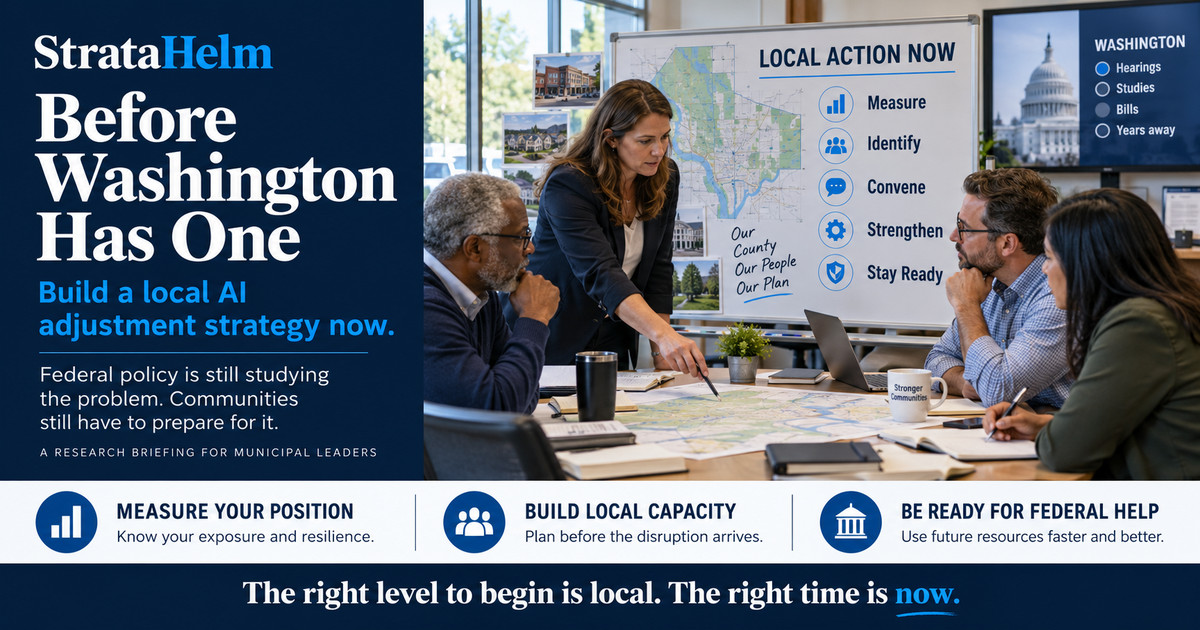
There is a natural instinct, when a problem feels national in scale, to wait for the national government to address it. On AI and jobs, that instinct is a trap. This briefing documents where federal policy actually stands as of late 2026 — a handful of bills, nearly all stalled at introduction, and nearly all proposing to study the problem rather than respond to it — and argues that communities cannot responsibly wait for that process to mature. The gap between the speed of the disruption and the speed of the federal response is the single most important fact for a local leader to internalize. Washington is, at best, years from a meaningful adjustment program, and the fastest-moving federal effort is a proposal to collect better data, not to help a single displaced worker. Meanwhile, AI adoption advances on its own timeline. The conclusion is not despair but initiative: the communities that build their own adaptation capacity now — measuring their exposure, planning their response, and strengthening their fundamentals — will be ready when disruption arrives and positioned to use federal resources well if and when they come. Local action is not a substitute for federal policy. It is the thing that has to happen first regardless.
It is worth being precise about the state of federal AI-workforce policy, because the reality is both less and more than the headlines suggest. There is genuine activity in Congress — several bills, bipartisan interest, hearings. But examine what the bills actually do and when they might take effect, and the picture clarifies quickly.
The through-line is unmistakable. The federal government is, at this moment, largely still deciding whether and how to study AI’s labor effects. More than forty labor and policy organizations felt compelled to write Congress in 2026 noting that it had been nearly two years since the Senate’s AI roadmap with no comprehensive legislation, and that "America’s workers cannot afford to wait" (Economic Policy Institute et al., 2026). That is an advocacy framing, but the underlying timeline is simply factual.
The fastest-moving federal response to AI job disruption is a proposal to measure it better. A measurement mandate is not a lifeline, and a study is not a plan.
Even on an optimistic timeline, the federal path is long. A bill must pass both chambers and be signed; a study must be commissioned, conducted, and reported; a program must then be designed, funded, staffed, and implemented; and only then does a dollar or a service reach a displaced worker in a specific town. That sequence routinely takes years even when there is consensus — and on AI there is not yet consensus even on what to measure. A community that waits for the end of that sequence is making a decision, whether it feels like one or not: the decision to meet the disruption unprepared, with whatever capacity it happens to have on the day the layoffs are announced. The history of deindustrialization is, in large part, the history of exactly this decision — the federal Trade Adjustment Assistance program existed, but the help arrived late, reached a minority of affected workers, and could not undo damage that had already compounded for years. Waiting did not spare those communities. It only ensured they faced the shock without a plan. What the federal retraining record shows for the workers it did reach is examined in The Time Horizon Trap.
Here is the argument that should settle the matter even for a leader inclined to wait: when federal help does arrive, it will demand exactly the local capacity that communities should be building now. Every serious proposal on the table — adjustment assistance, retraining grants, redeployment programs — will ultimately be administered through, or in partnership with, local and regional institutions. Federal money does not deploy itself; it flows to the places that can show where the need is, who is affected, and what the plan is. A community that has already measured its exposure, identified its vulnerable sectors and workers, and built the institutional muscle to respond will be first in line and most effective with whatever federal resources eventually appear. A community that waited will be starting from zero at exactly the moment speed matters most. Local preparation is not an alternative to federal policy; it is the precondition for using federal policy well.
And federal planning frameworks already require this groundwork: the economic-resilience and labor-market-analysis mandates in existing CEDS and WIOA rules are, in effect, a standing instruction to build local adaptation capacity — covered in Writing AI Resilience Into Your CEDS and Workforce Plan.
Beyond the timing argument, there are reasons local adaptation is simply the right level at which to act. AI’s effects are intensely local and uneven — a national program calibrated to national averages will fit almost no actual community, because exposure and resilience vary enormously from county to county. Local leaders know their employers, their workforce, and their institutions in a way no federal agency can. And the most effective responses in the record — employer-anchored sectoral training, economic diversification, entrepreneurial ecosystems — are built locally, with local knowledge, regardless of who funds them. Federal policy can supply resources and set standards, but it cannot supply the local knowledge and local relationships that make an adjustment strategy actually work. That part only a community can build, and it can start today.
"Build your own adaptation capacity" is only useful advice if it is concrete. A local AI adjustment strategy does not require a federal grant or a large staff to begin. It requires, in sequence:
Why those fundamentals are worth building even against an uncertain threat is the argument of The Adaptation Dividend; and the discipline of reading the measurement as position rather than prediction is laid out in Position, Not Prophecy.
A strategy built on measurement needs a measurement it can trust — and this is where the practical path forward becomes clear. The first two steps above, establishing a baseline and identifying vulnerabilities, require exactly the kind of comparative, documented, county-level exposure and resilience data that StrataHelm was built to provide: occupational exposure, economic concentration, adaptive capacity, and fiscal sensitivity scored for every U.S. county, with a published methodology and a confidence rating on every number. The intent is to give a community the infrastructure to begin a local adjustment strategy today — without waiting for a federal program to define the problem, fund the data, or grant permission to start. A leader does not need Washington’s timeline to know where their own community stands. That much is available now.
The temptation to wait for a federal answer is understandable, and on AI and jobs it is a mistake that the historical record has already punished once. Washington is years from a meaningful adjustment program and, at the moment, is still largely debating how to measure the problem rather than how to solve it. The disruption will not wait for that debate to conclude. The communities that come through this transition well will not be the ones that waited for a national plan and then scrambled to catch up — they will be the ones that measured their own position, built their own capacity, and strengthened their own fundamentals while the federal process ground slowly forward, so that they were ready for the disruption when it came and ready to use federal help well when it finally arrived. The right level to begin is local. The right time is now. Before Washington has an answer, a community can have a plan.
A local AI adjustment strategy starts with knowing where you stand — and every U.S. county’s CAERI baseline is available now, with the methodology published in full. See where your community stands →
U.S. Congress. S.3339, "AI Workforce PREPARE Act," 119th Congress (introduced December 3, 2025; directs a study of a potential Rapid AI Adjustment Assistance Program; remains in the Senate HELP Committee). congress.gov.
U.S. Congress. H.R.9381, "AWARE Act" (AI Workforce Assessment and Research Enhancement Act), 119th Congress (introduced June 22, 2026; directs BLS reporting on workplace AI use). congress.gov.
U.S. Congress. H.R.9427, "AI Workforce Impact Study Act of 2026," 119th Congress (introduced June 24, 2026). congress.gov.
Morgan Lewis (2026). "White House AI Framework Puts Federal Preemption at the Center of the Debate" (National Policy Framework for AI, March 20, 2026). morganlewis.com.
Economic Policy Institute, et al. (2026). "More Than 40 Organizations Call on Congress to Center Workers in Federal AI Legislation" ("America’s workers cannot afford to wait"). epi.org.
allwork.space (2026). "U.S. Senate Wants Better Data on AI’s Workforce Impact Before Crafting Policy." allwork.space.
Companion StrataHelm briefings: "Writing AI Resilience Into Your CEDS and Workforce Plan," "The Adaptation Dividend," and "Position, Not Prophecy." stratahelm.com/articles.