 HomeCountiesArticlesMethodologyContact
How to Brief Elected Officials on AI Exposure Without Causing Panic
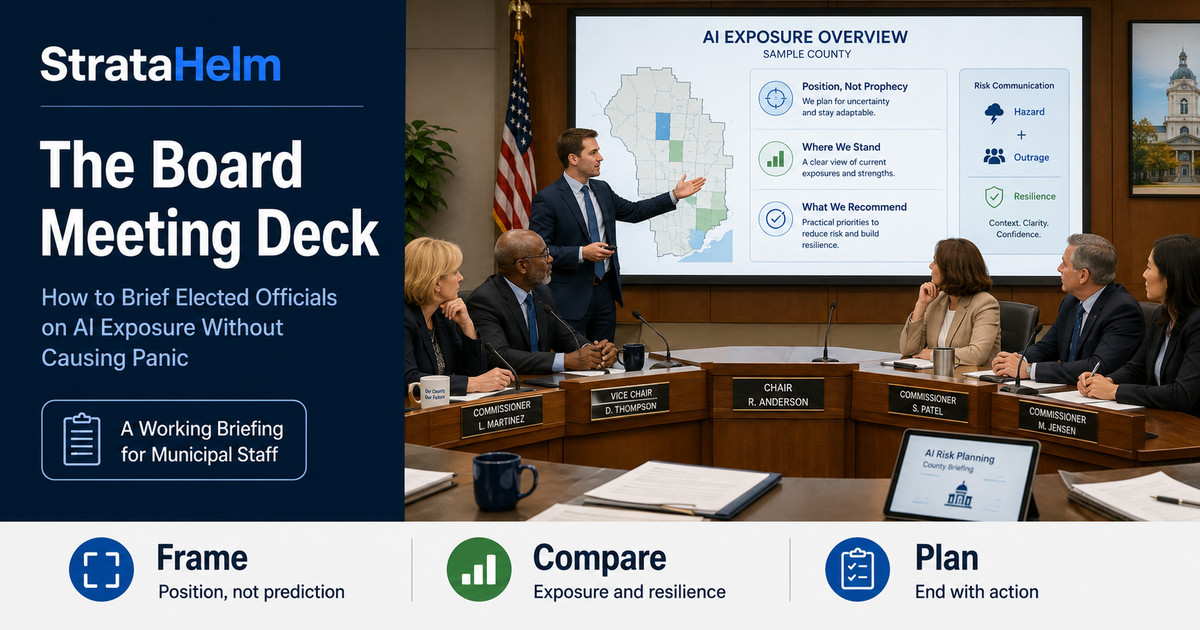
You have your county’s AI exposure data. Now you have to stand in front of a council or commission and explain it — to a room of elected officials, some skeptical, some anxious, at least one who will quote you to a reporter on the way out. Brief it badly and you get one of two failures: a panic that produces a rushed, symbolic overreaction, or a shrug that produces nothing at all. Brief it well and you get the thing you actually want — a board that understands the community’s position, supports a measured plan, and trusts you as the person who saw it coming. This briefing is a practical guide to that presentation. It draws on decades of established risk-communication research — the same principles emergency managers and public-health officials use — and translates them into a concrete deck structure, slide by slide, with language you can adapt. The core lesson from that research is counterintuitive and liberating: the goal is not to make people less afraid or more afraid. It is to align how alarmed they are with how serious the situation actually is, and to point that energy at something they can do.
Start with the single most useful finding in the entire field of risk communication, established by researchers including Vincent Covello and Peter Sandman: the risks that alarm people and the risks that actually harm them are often completely different. There is virtually no correlation between how dangerous something is by the numbers and how much public alarm it generates (Covello & Sandman, "Risk Communication: Evolution and Revolution"). Sandman compressed this into a formula every municipal leader should memorize: Risk = Hazard + Outrage. "Hazard" is the technical size of the problem. "Outrage" is everything else that drives how people feel — whether the risk feels voluntary or imposed, familiar or dreadful, controllable or not, fairly or unfairly distributed.
AI exposure is, almost by design, a high-outrage subject: it feels imposed rather than chosen, it is unfamiliar, it triggers dread, and it seems beyond any individual’s control. That means your audience’s emotional reaction will run ahead of the actual near-term hazard unless you actively manage it. The job of your briefing is not to inflate the alarm ("robots are coming for your jobs") or to suppress it ("nothing to worry about"). Both are failures. The job is to bring the alarm into line with reality and channel it toward preparation.
You are not there to calm the room or to scare it. You are there to make the room exactly as concerned as the facts warrant — and then to give that concern somewhere useful to go.
The most common briefing mistake is leading with data. Decades of practice point the other way: what an audience decides about your numbers depends on what they have already decided about you. Covello and Allen’s foundational Seven Cardinal Rules of Risk Communication, issued by the EPA in 1988 and still the backbone of the field, put "accept and involve the audience as a legitimate partner" and "listen" ahead of any discussion of the data itself (Covello & Allen, 1988). Elected officials, the research consistently finds, weigh trust, competence, fairness, and control far more heavily than they weigh quantitative risk estimates. Three things to settle before you open your slide software:
What follows is a structure, not a script — adapt the specifics to your community and your data. It is deliberately short. A briefing that runs long invites the audience to fill the time with anxiety.
Open by defining what this is and, crucially, what it is not. State plainly: "This is a measure of our position, not a prediction that anyone will lose their job." Borrow the flood-map framing — a flood map does not forecast rain; it shows where the water would go, so the community can prepare. This one move defuses more panic than any reassuring statistic, because it tells the room how to interpret everything that follows. Do not put a scary number on the first slide. Put the frame there.
The full flood-map framing is laid out in Position, Not Prophecy (published August 9, 2026), and its language is written to be lifted straight onto this opening slide.
Now the position: your community’s exposure and resilience, in comparative terms. "Compared to counties like ours, we are in the [upper third / middle / lower third] for exposure, and the [upper third / middle] for adaptive capacity." Comparison is what makes a number meaningful and what keeps it calm — an isolated figure invites catastrophizing, while a ranking against peers invites perspective. Show both sides: exposure and the strengths that offset it. Never show the hazard without the resilience on the same slide.
Translate the score into the two or three things this board actually cares about: the local employers or sectors most affected, the likely effect on the tax base, and the residents most exposed. Specificity here builds credibility and prevents the vague dread that generality produces. This is also the slide where the fiscal dimension belongs — elected officials who tune out labor statistics often snap to attention at revenue implications.
Counterintuitively, admitting what you do not know builds trust rather than eroding it — the research is emphatic that candor about uncertainty is a credibility asset, and that overconfidence, once exposed, is fatal to it. State the timeline honestly: meaningful effects are more likely over years than months, no one can predict the exact pace, and the estimate carries a confidence level. Officials who hear a measured account of uncertainty trust the presenter; officials who are handed false precision stop listening the moment reality diverges from the forecast.
End on action, always. The Seven Cardinal Rules are explicit that risk communication must include a discussion of what is being done or can be done (Covello & Allen, 1988). An audience given a hazard with no response defaults to either panic or denial; an audience given a hazard and a credible plan defaults to deliberation. Present two or three concrete, proportionate next steps — establishing a baseline, convening the right partners, targeting a specific vulnerability — and be clear about what you are asking the board to approve. Leave them with the plan on the screen, not the problem.
The same fact can be delivered to opposite effect. A few swaps worth internalizing:
The Q&A is where briefings are won or lost. Prepare for the predictable ones:
And the most important rule for the whole Q&A: if you do not know, say so, and say when you will follow up. One "I don’t know, I’ll find out by Friday" buys more credibility than a dozen confident guesses — and one exposed guess spends it all.
Everything above assumes you have a clean, credible, board-ready set of numbers to present — which is its own quiet challenge. A briefing built on a defensible, comparative, transparently-sourced measure carries an authority that a hastily assembled internal estimate cannot, particularly when an official asks the inevitable "says who?" This is precisely the gap a purpose-built exposure assessment is meant to fill: comparative positioning, the resilience side shown alongside the exposure side, a confidence rating that lets you brief uncertainty honestly, and output formatted for the room rather than for a data analyst. The goal is that when you stand up to present, the strength of the evidence is working for you — not something you are hoping no one probes.
Briefing elected officials on AI exposure is not fundamentally a data problem — it is a communication problem, and communication problems have been studied for decades by people whose audiences were facing floods, chemical spills, and epidemics. Their hardest-won lesson applies exactly here: your job is not to manage the facts but to manage the gap between the facts and the fear. Frame before you inform. Compare before you alarm. Pair every hazard with a strength and every problem with a plan. Admit what you do not know. Do those things, and a subject that could have produced a panicked overreaction or a fatal shrug instead produces the rarest thing in local government — a room full of officials who understand where they stand, trust the person who told them, and are ready to act while there is still time to act well.
Companion briefings: Position, Not Prophecy gives you the flood-map framing for Slide 1 in full, and Mind the Clock supplies the honest time-horizon language for Slide 4. Both are written to be quoted directly into a board presentation.
Slide 2 is your county’s position — and every U.S. county’s CAERI scorecard is free to look up, with exposure shown beside resilience and a confidence rating on every score. Look up your county →
Covello, V., & Allen, F. (1988). Seven Cardinal Rules of Risk Communication. Washington, DC: U.S. Environmental Protection Agency, Office of Policy Analysis.
Covello, V., & Sandman, P. (2001). "Risk Communication: Evolution and Revolution." In A. Wolbarst (ed.), Solutions to an Environment in Peril. Johns Hopkins University Press.
Sandman, P. (1993, updated 2012). Responding to Community Outrage: Strategies for Effective Risk Communication. American Industrial Hygiene Association ("Risk = Hazard + Outrage").
Fischhoff, B., Slovic, P., & Lichtenstein, S. (1986). "How Safe Is Safe Enough? A Psychometric Study of Attitudes Towards Technological Risks." Risk Analysis, 6(4), 403–415.
U.S. Centers for Disease Control and Prevention. Crisis and Emergency Risk Communication (CERC) Manual (principles on trust, uncertainty, and action). cdc.gov.
Companion StrataHelm briefings: "Position, Not Prophecy" and "Mind the Clock." stratahelm.com/articles.