 HomeCountiesArticlesMethodologyContact
How to Build an AI-Transition Task Force That Actually Does Something — Who Belongs at the Table, What to Measure, and How to Keep It From Going Symbolic
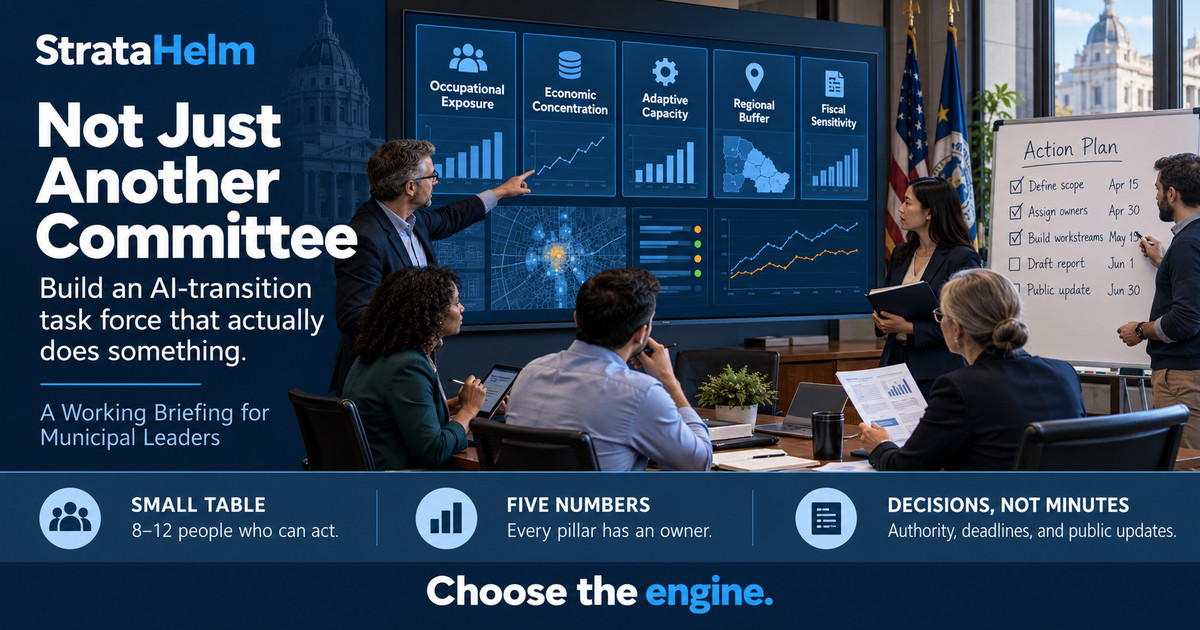
The moment a community starts worrying about AI and jobs, someone proposes a task force. It is the reflexive municipal response to any large, ambiguous threat, and it fails in a predictable way: a group of worthy people convenes, issues a report, poses for a photo, and dissolves — having changed nothing. The problem is not the instinct to convene; coordinating a response genuinely does require getting the right people in a room. The problem is that most task forces are built to produce a document, not a result. This briefing lays out how to build the other kind: who actually belongs at the table and who does not, what the group should measure so its work is anchored to evidence rather than opinion, the specific design choices that keep it from decaying into theater, and a template agenda organized around the five dimensions of community AI exposure — occupational exposure, economic concentration, adaptive capacity, regional buffer, and fiscal sensitivity. The difference between a task force that matters and one that is quietly forgotten is almost entirely in the design. Get the design right and you have an engine. Get it wrong and you have a committee.
It is worth diagnosing the failure precisely, because the symbolic task force fails for specific, avoidable reasons. It usually has no baseline — it convenes to discuss a problem no one has measured, so its conversation runs on anecdote and anxiety rather than evidence. It usually has no decision authority — it can recommend but not act, so its output is advisory and easily shelved. It usually has no deadline and no metrics — nothing distinguishes a meeting where real work happened from one where it did not, so attendance drifts and urgency fades. It is often too large and too honorific — built to confer status on its members rather than to get work done, which guarantees that no one in particular is accountable for anything in particular. And it usually has no defined end state — no answer to the question "what does success look like and when are we done?" A group with no baseline, no authority, no deadline, no metrics, and no end state will produce exactly what its design permits: a report. The symbolic task force is not a failure of the people on it. It is a failure of how it was built.
A task force built to produce a document will produce a document. A task force built to change a number will change a number. The design decides which one you get before the first meeting.
The composition of the group is the first design decision and the one most often botched, because the instinct is to invite everyone important rather than everyone necessary. Keep it small enough that every member has a reason to be there and a job to do — generally eight to twelve people, not thirty. The essential seats:
Just as important is who does not get a permanent seat: anyone there purely for prestige, anyone who cannot commit to the work between meetings, and the merely curious. Honorary members make a group larger, slower, and less accountable. Bring in outside expertise as needed, but keep the working core lean.
The single design choice that most separates a working task force from a symbolic one is whether it is anchored to a measurement. A group that starts from a shared, quantified baseline argues about what to do; a group without one argues about whether there is even a problem, meeting after meeting. Anchor the task force to the five dimensions of community AI exposure, give each a metric and an owner, and the work organizes itself:
Each of these is a dimension a composite exposure index already scores, so the task force does not start from a blank page — how to read those scores as position rather than prediction is covered in Position, Not Prophecy, and why residence-side and workplace-side exposure must both be tracked is covered in Resident Exposure vs. Employer Exposure.
The discipline is simple: every pillar has a named owner, a current number, and a target or trend the group reviews each cycle. A task force that can answer "where do our five numbers stand and which way are they moving?" is doing real work. One that cannot is having a conversation.
Beyond composition and measurement, a handful of structural choices determine whether the group stays an engine or decays into theater. Build these in from the first meeting, because they are nearly impossible to add later.
That last point matters because the groundwork the task force produces is exactly what federal planning frameworks already require — the economic-resilience and labor-market analysis mandates covered in Writing AI Resilience Into Your CEDS and Workforce Plan — so the work counts twice.
It is also the local capacity any eventual federal response will ask communities to show, as argued in Before Washington Has One.
A working task force needs a repeatable meeting structure, so that each gathering advances the same five fronts rather than wandering. The following template can anchor a recurring meeting — monthly at first, then quarterly once a baseline and plan are in place. Adapt the specifics; keep the bones.
Opening (10 minutes) — Decisions and accountability. Review decisions made last cycle and whether assigned actions were completed. Name anything that slipped and why. This opening, not the discussion that follows, is what keeps the group honest.
Pillar round (5–10 minutes each) — The five numbers. Each pillar owner reports in turn: the current figure, the direction since last review, and anything that changed. Kept tight, this is the analytical heart of the meeting and the thing a symbolic committee never has.
Decision block (20–30 minutes) — What we are doing about it. The deliberate core: one or two substantive decisions per meeting, each leaving the room with an owner and a deadline. Rotate focus so that over a few cycles every pillar receives real strategic attention, not just a status read.
Close (5 minutes) — Assignments and the public line. Confirm who owns what by when, and agree on what will be reported publicly before the next meeting. End every meeting knowing exactly what each member is accountable for and what the community will be told.
A task force, however well built, is a coordinating mechanism — not a substitute for the underlying work of diversification, training, and fiscal preparation that the companion briefings describe. The best-designed group in the country will accomplish nothing if its members treat the meeting as the deliverable. The structure here exists to make the real work happen and to keep it visible and accountable; it is scaffolding, not the building. The case that most of that underlying work pays off whether or not AI disrupts a single job is made in The Adaptation Dividend. A community should measure its task force the way the task force measures its economy — by whether the numbers that matter actually move. If after a year the five pillars are better understood, actively owned, and trending in the right direction, the group is working. If the only output is a thicker binder, it has become the thing it was built to avoid.
Every community facing AI disruption will be tempted to convene a task force, and most of those task forces will accomplish nothing — not because the threat is unreal or the people unwilling, but because the groups are built to deliberate rather than to act. The difference is in the design, and the design is not complicated: a small table of people who can actually do things, a shared baseline across the five dimensions of exposure, a named owner for every number, a charter with authority and an end state, and a meeting structure that produces decisions instead of minutes. Build it that way and the task force becomes what the moment requires — the engine that turns a community’s anxiety about AI into a measured, accountable, public plan. Build it the usual way and it becomes one more committee, meeting earnestly while the thing it was convened to address moves on without it. The choice is made at the first meeting, in how the group is designed. Choose the engine.
For the evidence on which interventions a task force should actually fund, see What Actually Works; and for how to present the group’s findings to elected officials without causing panic, see The Board Meeting Deck.
A working task force starts from a shared baseline — and CAERI scores all five pillars for every U.S. county, free to look up, with the methodology published in full. See where your community stands →
The five-dimension framework — occupational exposure, economic concentration, adaptive capacity, regional buffer, and fiscal sensitivity — follows StrataHelm’s Community AI Exposure and Resilience Index (CAERI). stratahelm.com/methodology.
On the federal planning mandates a task force’s work satisfies: 13 C.F.R. § 303.7 (CEDS economic-resilience requirement) and 20 C.F.R. §§ 679.510 / 679.560 (WIOA regional and local labor-market analysis). See "Writing AI Resilience Into Your CEDS and Workforce Plan."
On the interventions a task force should prioritize and the evidence behind them, see "What Actually Works" (sectoral training RCT evidence) and "The Adaptation Dividend" (no-regret investments).
Companion StrataHelm briefings: "Position, Not Prophecy," "Resident Exposure vs. Employer Exposure," "Writing AI Resilience Into Your CEDS and Workforce Plan," "What Actually Works," and "The Board Meeting Deck." stratahelm.com/articles.