 HomeCountiesArticlesMethodologyContact
Why Every Community Deserves a Shared, Transparent, Public Standard for Measuring AI Exposure
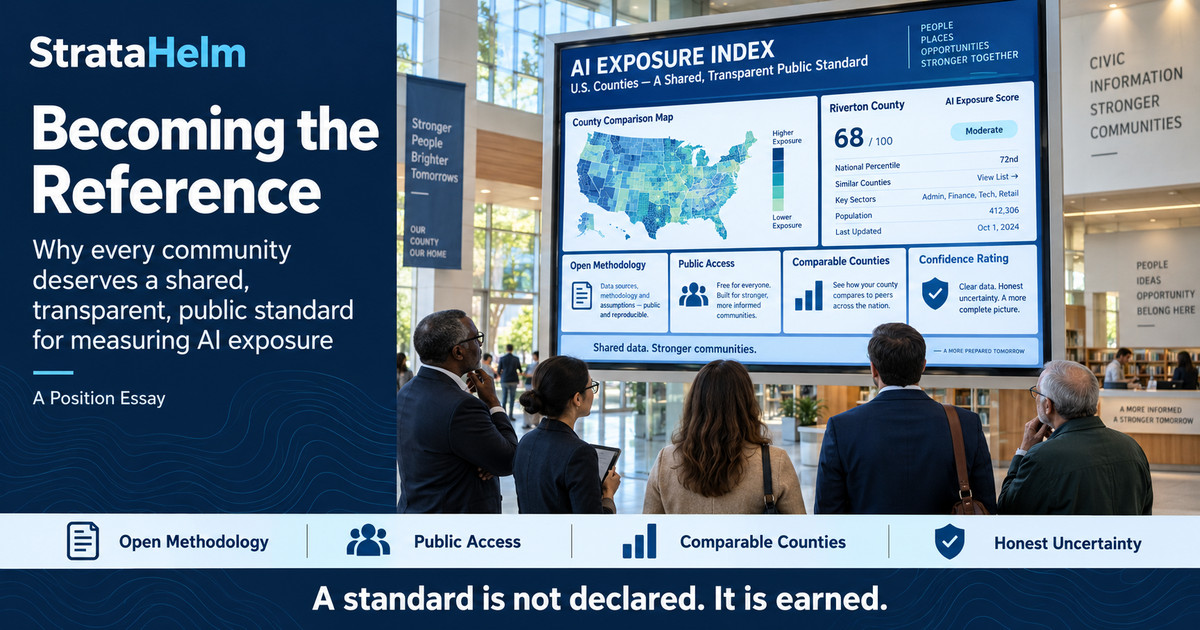
Some of the most consequential numbers in American life are shared public standards. The unemployment rate, gross domestic product, the Consumer Price Index, the Air Quality Index, the flood map — each takes something sprawling and hard to see and compresses it into a single, comparable, trusted figure that everyone reads the same way. These measures are not merely data. They are coordination infrastructure: they let a mayor, a lender, a business, a journalist, and a resident argue from the same facts. Artificial intelligence is now reshaping local labor markets community by community, and there is no such shared measure for its effects. Every county is left to guess, to trust a proprietary black box, or to look away. This essay argues that this gap is untenable — that every community deserves a standard measure of its AI exposure, built to the same principles that made the great public statistics trustworthy: open methodology, universal coverage, public access, honesty about uncertainty, and grounding in credible research. It then makes a quieter argument: that a standard is not declared but earned, by meeting those principles and inviting the scrutiny that proves it. We built our index to be judged that way.
Consider how the most important economic statistic in the world came to be. In 1932, the United States was in the depths of the Great Depression and could not measure its own predicament. Congress could observe breadlines and read the stock ticker, but no single, systematic number captured how far the economy had fallen. So Congress commissioned a 31-year-old economist named Simon Kuznets to build one. In 1934 he delivered a report to the Senate that introduced what would become Gross Domestic Product — a single, comparable, regularly updated figure that could tell the country whether its economy was growing or shrinking (Kuznets, "National Income, 1929–1932," Senate Document No. 124, 1934). It transformed governance. For the first time, a nation could see the thing it was trying to manage.
And here is the part too often forgotten, and most instructive for us. Kuznets did not oversell his own creation. Under a section heading he wrote himself — "Uses and Abuses of National Income Measurements" — he cautioned that "the welfare of a nation can scarcely be inferred from a measurement of national income" (Kuznets, 1934). He shipped the measure and its limits in the same document. The lesson is not that GDP was flawed; it is that a measure earns trust precisely by being honest about what it can and cannot see. The best public standards have always come with their own warning labels. That is a feature, not an apology. Kuznets's caution is also not a historical footnote: the gap between a healthy national aggregate and a community coming apart underneath it is the subject of Painful Growth, and it is exactly why a national number needs a local companion.
A crisis you cannot measure is a crisis you cannot manage. The first act of governing a disruption is building the instrument that lets you see it.
It is worth being precise about why a shared standard is worth more than a pile of good data. A private analysis, however sophisticated, informs one decision-maker. A standard coordinates all of them. When everyone references the same measure, several things become possible that are otherwise not. Communities can be compared, honestly and consistently, rather than each grading its own homework. Actors who never speak to each other — a county budget office, a state workforce board, a bank, a foundation, a newspaper — can nonetheless act from a common picture. Accountability becomes possible, because a shared measure can be tracked over time and no one can quietly move the goalposts. And ordinary people gain the power to ask an informed question about their own community, which is the quiet foundation of democratic self-government. The Air Quality Index does not clean the air; it lets a parent, a school, and a city all decide what to do about it from the same number. That is what a standard is for.
Not every number deserves to become a standard, and some that have achieved the status did not deserve it. The proprietary credit score, for instance, became critical public infrastructure while remaining an opaque black box its subjects could not inspect — a cautionary tale, not a model. If a measure of AI exposure is going to earn a community’s trust and guide real decisions, it must meet a demanding set of principles. This is the heart of the argument, and it applies to any such measure, whoever builds it.
The most important of these — honesty about what the number is — has its own full treatment in Position, Not Prophecy, which argues that an exposure measure is a flood map, not a forecast.
If communities do not get a standard built on these principles, they will not simply get nothing. They will get worse than nothing: a fragmented landscape of incompatible proprietary scores, each measuring something slightly different by methods no outsider can inspect, sold to whoever can afford them and invisible to whoever cannot. In that world, two neighboring counties cannot compare their situations because they bought different products. A journalist cannot verify a vendor’s claim because the method is a trade secret. A small rural county gets no measure at all because it was never a viable customer. And the national conversation about AI and place stays exactly as it is today — a shouting match of anecdotes and forecasts with no shared factual ground to stand on, and usually without even a date attached to the claim. The absence of a good public standard is not neutral. It is an active harm, and it falls hardest on the communities with the least capacity to fend for themselves.
This essay has, until now, argued about principles rather than products, and deliberately so — the case for a standard does not depend on who builds it. But candor requires stating our own position. We built the Community AI Exposure and Resilience Index to these principles, on purpose, because we believe this is what a legitimate standard demands: an open, published methodology; consistent scoring for every U.S. county; a public baseline that a small county can consult for free; a confidence rating on every score and an insistent "position, not prophecy" framing; grounding in the peer-reviewed occupational-exposure literature; and a maintained, versioned commitment rather than a one-off report. That this work is done by a company that is genuinely optimistic about the technology it measures is not a contradiction, and Where We Stand sets out why. We are not asking anyone to take the resulting number on faith. We are asking the opposite — to check it against the principles above, and against the data, and to hold it to the standard this essay describes. A measure that asks for trust has already failed. A measure that invites scrutiny is the only kind that can earn it.
A standard is not announced. It is adopted — by being used, cited, checked, and found to hold up. That is a verdict others render, not one we can claim.
So this is finally an invitation rather than a declaration. To municipal leaders: use the measure, and judge it by whether it helps you see your community more clearly — put it to work in the CEDS or workforce plan that already obliges you to analyze exactly this, and, when the time comes to put it in front of a council, brief it without causing panic or a shrug. To researchers and skeptics: inspect the methodology, test it, and tell us where it falls short — that scrutiny is how a standard improves and how it earns its legitimacy. To journalists: verify before you cite, as you would with any figure. To every community that has been left guessing about what AI means for its people and its budget: you deserve a number you can trust, compare, and act on, built in the open and honest about its own limits. Whether the index we built becomes the reference is not ours to decree. But that some such standard must exist — that every community deserves to know where it stands, in terms it can check — seems to us beyond argument. The great public measures were all, once, someone’s proposal that the world had not yet agreed to use. This is ours.
Ninety years ago, a nation that could not measure its own economic collapse commissioned a single number so that it could finally see — and its author had the wisdom to ship the number’s limits alongside it. We face a smaller but real version of the same problem: a technological disruption reshaping communities one at a time, with no shared, trustworthy way to see where any given community stands. The answer is not another forecast, another proprietary black box, or another counsel to wait. The answer is a standard — open, universal, public, honest, grounded, and maintained — that lets every community read its own position in terms it can compare and check. Every community deserves that. We built our best attempt at it, in the open, and we would rather be measured against these principles than believed on our word. That is what it means to try to become the reference: not to be trusted, but to be checkable — and to invite the world to check.
To read the measure this essay describes as position rather than prophecy, start with Position, Not Prophecy; for the vocabulary behind it, see A Municipal Leader’s Glossary for the AI Economy.
See the standard for yourself — every U.S. county’s CAERI score, with the methodology published in full and a confidence rating on every number. Look up your community →
Kuznets, S. (1934). "National Income, 1929–1932." Report to the U.S. Senate, 73rd Congress, 2d Session, Senate Document No. 124 (introducing national income accounting; section "Uses and Abuses of National Income Measurements"; "the welfare of a nation can scarcely be inferred from a measurement of national income," p. 7).
On GDP’s history and Kuznets’s cautions: World Economic Forum (2021), "A Brief History of GDP"; New America, "Measuring What Matters"; and Landefeld, Seskin & Fraumeni (2008), "Taking the Pulse of the Economy: Measuring GDP," Journal of Economic Perspectives, 22(2).
On public indices as coordination infrastructure: U.S. Environmental Protection Agency, Air Quality Index (AQI); U.S. Bureau of Labor Statistics, unemployment rate and Consumer Price Index; Federal Emergency Management Agency, National Flood Insurance Program flood maps.
Occupational-exposure research underlying the standard discussed: Autor, Levy & Murnane (2003); Felten, Raj & Seamans (2021); Eloundou et al. (2024). See "A Municipal Leader’s Glossary for the AI Economy."
Companion StrataHelm briefings: "Position, Not Prophecy" and "A Municipal Leader’s Glossary for the AI Economy." stratahelm.com/articles.